Goongillings Exploration and Picnic
Sunday, 5th September 2010
“I waved goodbye to the couple I had just killed”. What an excellent quote to relate to Amanita phalloides, the Death Cap fungus. Pauline Penna had just dug one from the field adjacent to Scott’s Wood and she passed it round the group, pointing out that the gills were white, not grey-black as in a mushroom.
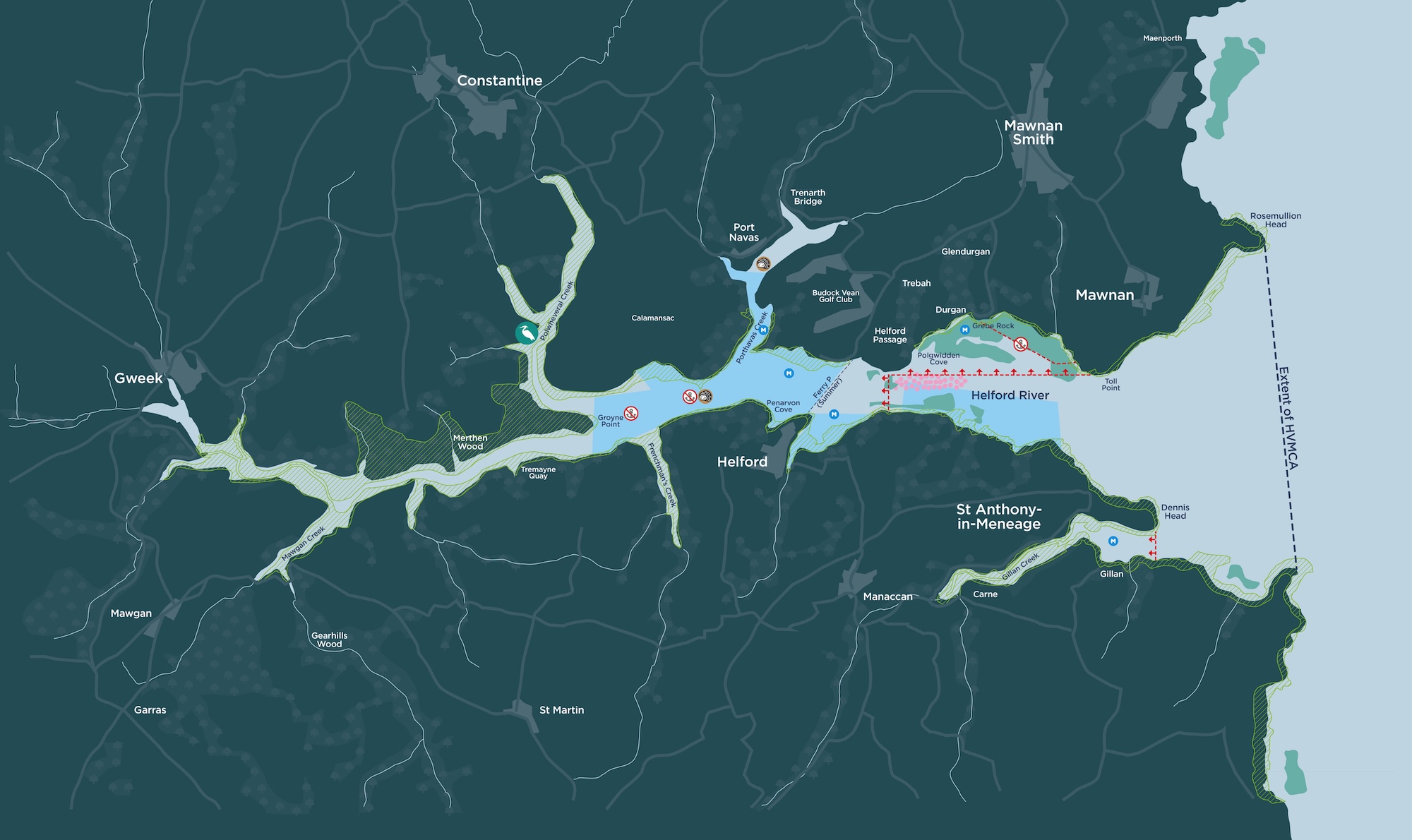
The morning had been unpromising, with heavy downpours. Fortunately after lunch the rain stopped and 25 hardy folk assembled for the Goongillings Exploration and Picnic (the latter component, by unspoken agreement, being abandoned). There was a wealth of expertise: Peter Ealey to deal with geology, Ian Bennallick (plants), Pauline Penna (fungi), Martin Rule (birds), Pamela Tompsett (shorelife), Sue Scott (ERCCIS) and Charles Pugh, Goongillings farmer / owner, who gave us an introductory talk about the farm’s history and current status. Early connections had been with the Trewardreva Estate. Scott had inherited the property through marriage in the early 1800s and built the track and quay on Polwheveral Creek to export granite from Constantine quarries via merchant schooners. Subsequently it was purchased by the Vyvyans of Trelowarren and then Mrs Hext of Trebah. Charles’ father had bought Goongillings about 50 years ago and for the past 30 years it has been farmed by Charles as an organic enterprise without fertilisers or chemicals and adopting a philosophy of ‘benign neglect’, allowing natural regeneration. In consequence, Goongillings has a species-rich fauna and flora and is justifiably part of the Countryside Stewardship scheme.
The track from Constantine to Scott’s Quay runs south along the watershed between two valley-creek systems: Nancenoy-Polpenwith on the west and Polwheveral on the east. From each side the road climbs very steeply to the farm, which is situated on the cusp of the watershed. Peter showed a geological map which demonstrated that there is a southward bulge of the Carnmenellis granite at this point, such that Nancenoy and Polwheveral valleys (and the remainder of the farm) are underlain by muddy rocks of the Mylor Slate Series while to the north of the farm the soils are markedly different, derived from the granite. Evidence of thermal metamorphism can be detected near the granite.
We moved south along the track, close to an Iron Age settlement and then to an open-fronted barn, formerly used by Charles’ father as a hangar for his light aeroplane, adjacent fields forming the runway. A barn owl is an occasional visitor, although it ignores the nest box. From this point there was a good view across Polwheveral Creek to Calamansack, producing discussion on the possible line of the iron lodes shown on the geological map. More obvious was the broad area of heathland on ground too steep for farm machines. Charles expressed his opinion that this uncommon habitat, an almost impenetrable mix of heather, bramble, gorse and coarse grass, probably represented natural recolonisation of land that had once been cultivated.
Passing into Scott’s Wood, Pauline was kept busy identifying the fungi discovered by the party, apart from a short diversion to a tree where a prisoner-of-war farm worker had carved his name and number. The air was still damp and the sky overcast. Insects and birds had so far been absent; and then a member of the party, at the edge of the creek with binoculars, spotted a stationary group of birds on the far bank. Martin identified them as six greenshank and a redshank, the former being larger, paler, with more distinct whitish underparts than the brown-tinged redshank. High tide precluding an examination of the shoreline, we continued along the side of the creek through mixed woodland containing oak, coppiced sweet chestnut, birch and beech. Then Peter decided that high water made it impractical for the party to visit the exposure of folded and frost-shattered Mylor Slates near Scott’s Quay and so the group headed off to a depression downslope from the Iron Age settlement where Charles has developed a freshwater pond.
A variety of wildlife was present here. Common blue damselfly and blue-tailed damselfly were seen in the reeds. Numerous small frogs were hopping in the grass around the pond, to the delight of the children. Meanwhile Ian and Pauline were speculating on a link between a fungus and the root system of an aspen tree several metres away. Martin heard the call of a great spotted woodpecker and eventually located it in nearby woods. Peter and another of the party branched off into the woods to seek the iron ore workings. On the return uphill to the farm Ian pointed out the large variety of ground plants, including black nightshade.
Overall, the poor weather had limited the chances of seeing many insects and birds, but there had been a positive side. The experts were all together and it was informative to listen to discussions which showed the interplay of their different disciplines. The HMCG wishes to express its thanks to all the leaders, to Charles for allowing us to come and to the members for supporting the event.