Helford Conservation Cruise
Sunday, 21st June 2009
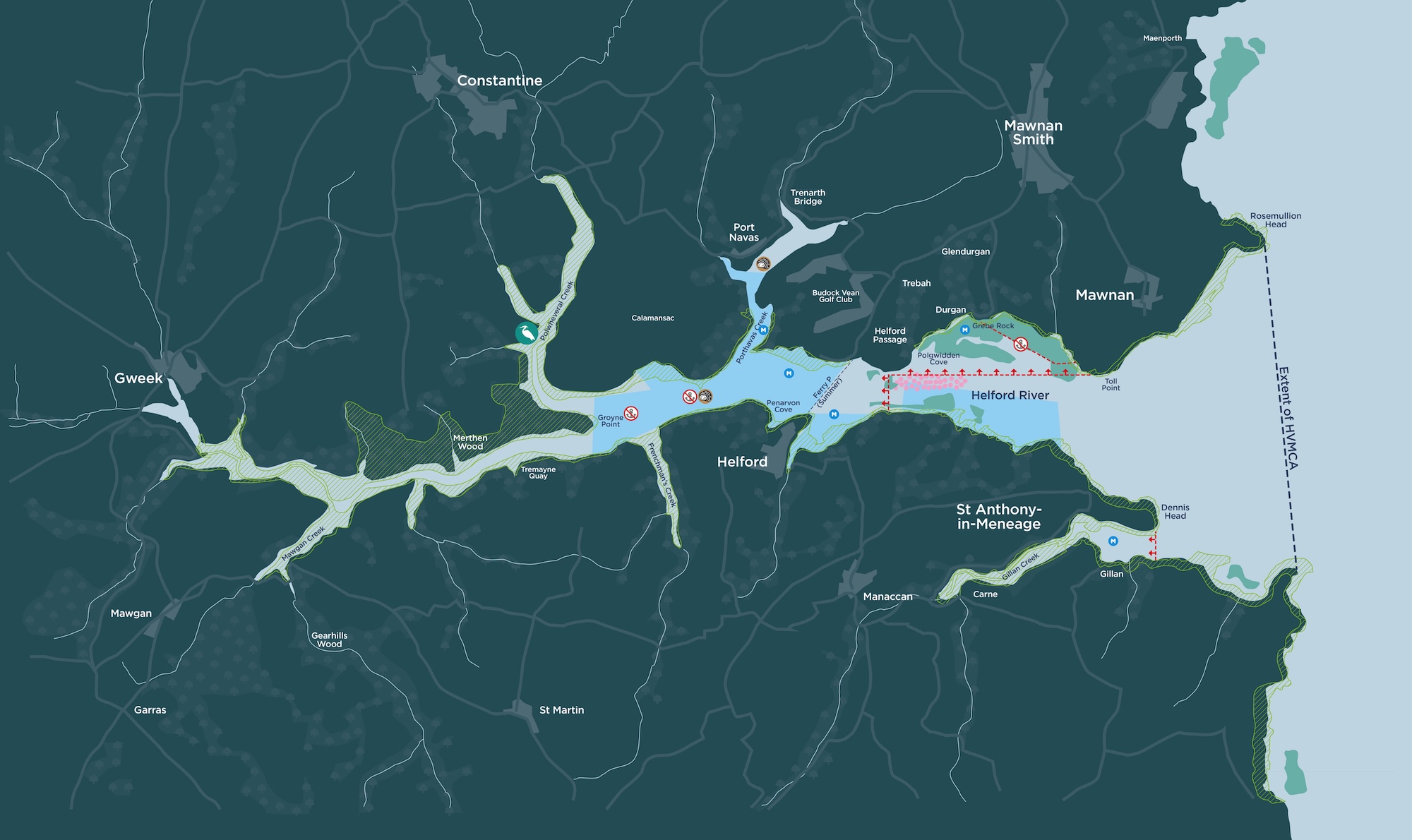
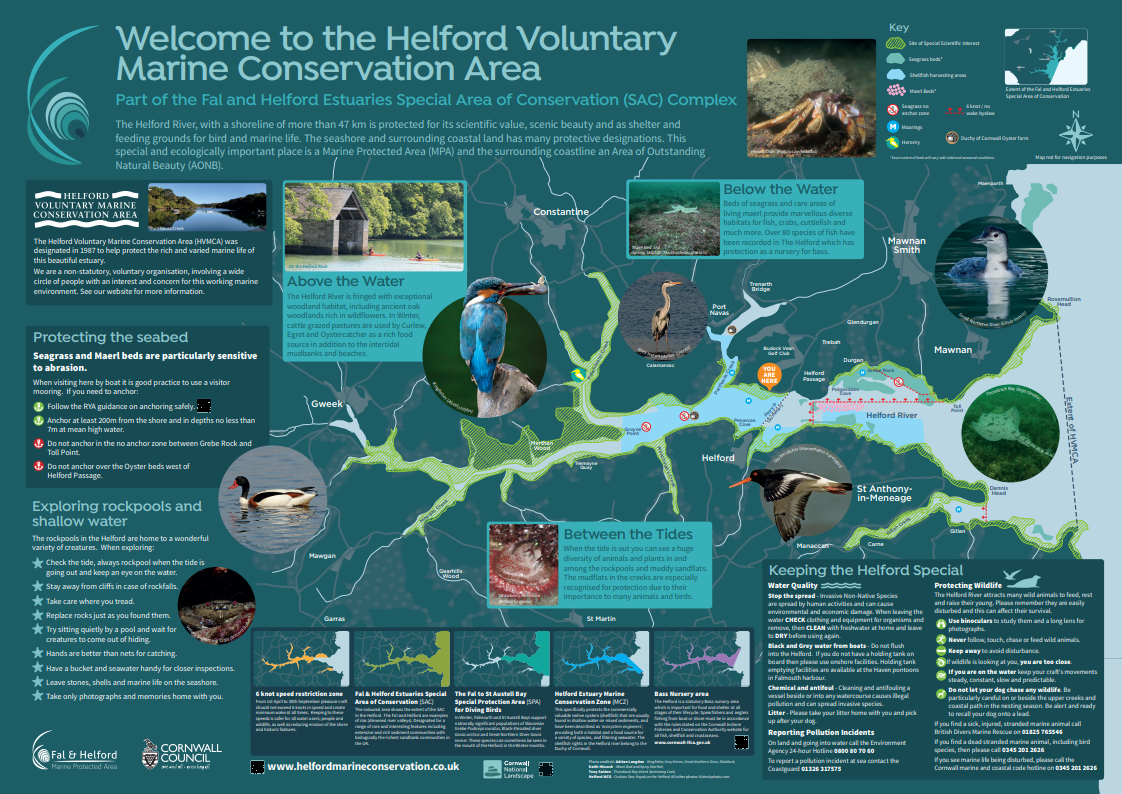
It was a glorious day – the sort of weather one always hopes for, with a warm sun, hardly a cloud in the sky and negligible breeze. The boat was unfortunately late in arriving, but the 100 passengers were very patient, enjoying the sunshine, watching holidaymakers and having an occasional ice cream. Setting off, we motored up Porth Navas Creek to see the Duchy Oyster Farm and Childrens’ Sailing Club, then across to the mouth of Frenchman’s Creek, where Justin Whitehouse of the National Trust took up the commentary. The house overlooking the creek is ‘Powders’, built in the 1920s by Powders Thorburn, a colourful character, part author, part artist, part (alleged) gun-runner. It has been converted by the National Trust into an eco-friendly holiday cottage. On, westwards, to Tremayne Quay, said to have been built for a possible visit by Queen Victoria, and then to a boathouse, which is home to Greater Horseshoe Bats and Barn Owls, now living in relative harmony since the Trust provided them with separate ‘apartments’. The woods on either side, Tremayne Woods on the south and Merthen Woods on the north, are SSSIs, fine examples of ancient sessile oak woodlands reaching down to the water’s edge. A few non-native trees such as beech and sweet chestnut occur. Tremayne Woods contains six species of bat, including the rare Daubenton’s bat.
The boat weaved its way up the channel to Gweek, where Rhiannon pointed out the National Seal Sanctuary and the beds of Spartina grass, a nursery for young bass. Gweek gained importance after the growth of Loe Bar ended the days of Helston as a port. It now deals mainly with leisure craft, but Seacore, the offshore drilling company with headquarters in Falmouth, still uses its original site and quay; and it was there that the captain deftly turned the boat for the return journey. Moving up Polwheveral Creek, Andrew Tompsett at the microphone became increasingly excited as we approached the heronry-cum-egretry on the west bank. There were 6, or was it 12, or possibly 20 Little Egrets in the trees. They came to this area about 10 years ago, joined the herons and are now a breeding colony with about 7 nests. Another U-turn and we moved out of the creek, disturbing three shelduck and a pair of mallards. Pamela recalled the beginning of the HVMCA and spoke of the importance of the thick muddy sediments, home to a great variety of sea creatures. An initial worry was the level of contamination caused by TBT antifouling on boats, but thankfully this is no longer permitted.
The creek opened out and we threaded our way through a host of moored boats, mostly expensive yachts, but including boats from the fishing fleet. David Muirhead gave us a lot of details – owners, where built, what type of fishing – and then went on to speak of the new Marine Bill currently being formulated. Within a few years it is expected that fisheries will be organised into Inshore Fisheries Conservation Authorities and that there will be more Marine Protected Areas. Helford fishermen are already operating voluntary restrictions in an area from Falmouth Bay to Manacle Point. Continuing to the mouth of the estuary, Justin drew attention to the building on Nare Point, a look-out and torpedo-testing station in WWII and now occupied by Coastwatch to monitor shipping. During the war, Ealing Studios had built a replica of Falmouth docks and railway in this area as a decoy, clearly successful as it had been bombed twice. At the entrance to Gillan Creek were two small National Trust properties, one containing ancient pottery remains.
On the return journey now, we heard about the geology. The rocks on either side of the Helford are about 380 million years old, a group of mudstones, siltstones and sandstones laid down on the sea bed and derived from the erosion of mountains in Wales. About 300 million years ago they were folded, tilted and intruded by large granites. The major rivers in Cornwall all drain south, the Tamar and Fal opening into magnificent harbours. Wave-cut platforms at different elevations, for example the top of the Lizard peninsula, about 2.5 million years old, indicate a rise in the land relative to sea level. During the Ice Age, sea level fell dramatically, to about 120m lower than today. When the ice melted, 17,000 to 7,000 years ago, sea level rose quickly, flooded the valleys and caused the rivers to drop their sediments in the valleys, producing today’s muddy creeks.
Motoring past Durgan, Rhiannon pointed out the ‘no anchoring’ buoys, protecting important eel grass beds, and talked about the broader Fal and Helford Special Area of Conservation, with its varied range of rocky, sandy and muddy habitats. David Muirhead wound up, with thanks to the captain and crew of Enterprise Boats, Nick Bailey and his team for use of the jetty, Justin Whitehouse and National Trust helpers for live tank displays, Derek Goodwin who had brought live young bass, the speakers; and the members, who had supported a very enjoyable cruise.
