Seashore Safari

Saturday, 25th July 2009

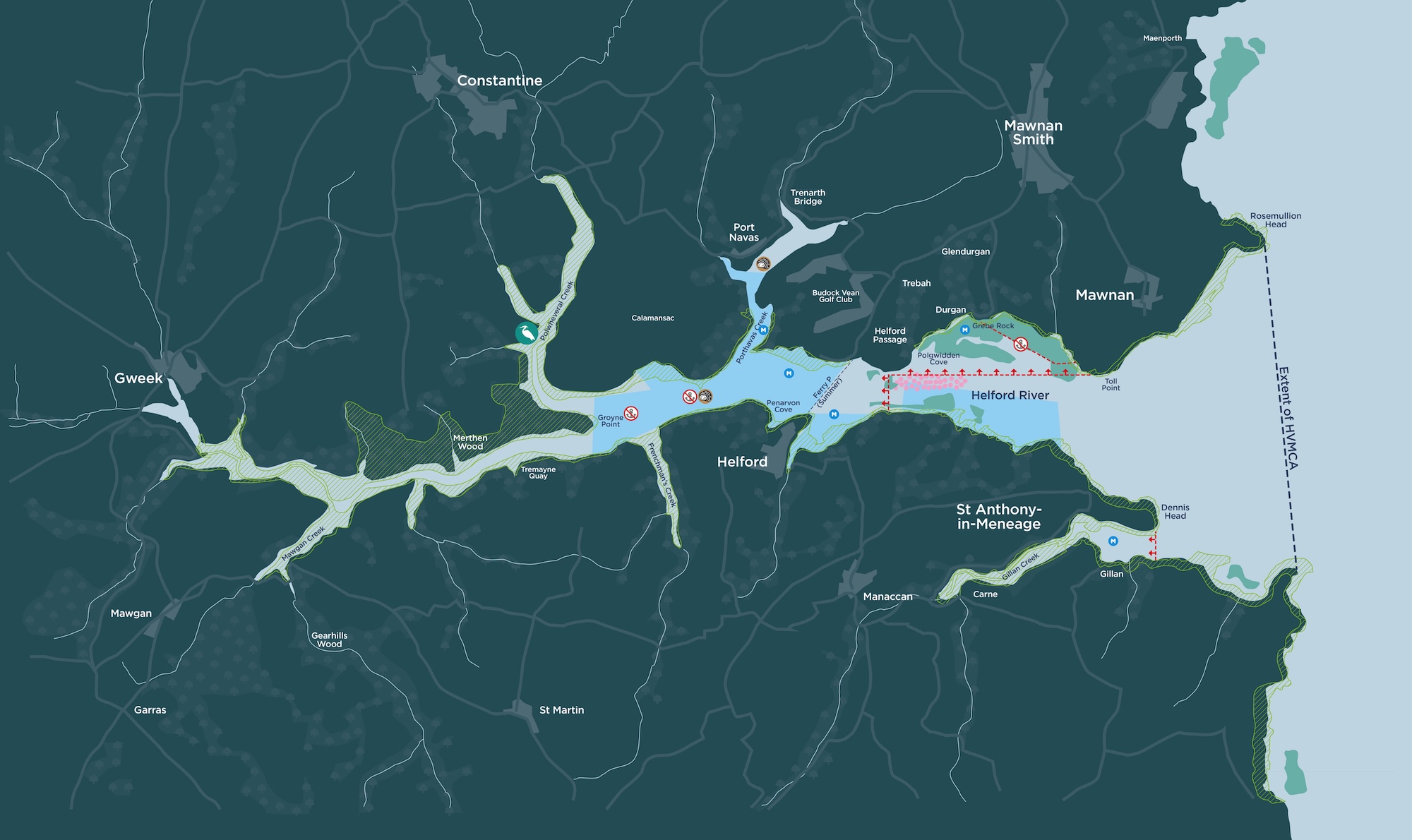
Clearly something interesting was about to happen as a group of nearly 30 people, adults and children, gathered on the beach at Helford Passage for a short introductory talk by Ruth Williams, Cornwall Wildlife Trust’s Marine Officer. Then, armed with an assortment of nets, buckets and trays, we set off, clambering over limpet- and barnacle-strewn rocks to the shallow pools left by the receding tide. The Seashore Safari had begun. Weather conditions were ideal – sunny and warm with a slight breeze. Intrigued holidaying families joined in; and by now the numbers had swelled to 40, of whom half were children.

Success was ensured as 20 young, sharp-eyed explorers scoured the area, moving the seaweed, probing crevices, carefully turning over stones (and replacing them afterwards) and bringing anything that moved to Ruth for identification. “That’s a pipe fish. See its horsey face, it’s related to seahorses. Feel how bony it is. In some areas puffins collect these to feed their young, because there is a shortage of sand eels, but there is not much nutrition in a pipe fish and the young birds die”. “That fish is a blenny. Its top fin is continuous along the body, whereas the goby has a notch in the top fin”.

There were crabs galore, mostly small green shore crabs, a few small brown edible crabs and several finds of hermit crabs. One could tell the sex of the crab by looking at the underside, the female having a broad tail to cover her eggs. Ruth gave a graphic account of how a crab withdraws its body from its outgrown shell and then expands, so that its newly forming shell will have space for further growth. Her role-play so impressed a young lad that he repeated it an hour later. Common starfish, anemones and various top shells had now been added to the collection.

Moving down to the sands of the lower shore we came across various wracks, kelp and sea lettuce and were assailed by pulses of water expelled by sea squirts. Sediment-crusted tubes of the peacock worm were in evidence. The young explorers were still bringing their finds: a couple of razor shells, the shells of oyster and scallop and a cluster of slipper limpets, an alien species that competes with the oyster. All too soon, it seemed, the afternoon drew to a close and the participants departed, but not without sincere thanks to Ruth who had made it such an enjoyable and worthwhile outing.

Similar Posts

  • Fabulous Wooded Garden Walk, Gillan Creek

    Free for under 18s and HMCG members. £4 for others. Meet at Hallowarren Barn, Carne. SW 7729 2487  A very rare opportunity to stroll through a fabulous 15 acre woodland garden and wildflower honeypot meadow with owner Amanda Loxley.  There will be a circular walk through the unspoilt woodlands early summer flowers time finishing with…

  • Coastal Ketches and Inside Barges (Andy Wyke)

    14 January 2012

    ‘A sewn boat? What’s that?’ ‘Well, it was a way of constructing boats in the Bronze Age, about 2500 BC, before nails had been invented. With the tools available at the time, bronze axes and adzes, logs would be split and fashioned into planks, to be stitched edge-to-edge with fibres from yew branches. Moss was used for caulking.’

    Our speaker, Andy Wyke, was well qualified to tell us. As Boat Collection Manager at the National Maritime Museum Cornwall, he has been one of the prime movers in a project which will use ancient tools to build a 60ft replica Bronze Age boat at the museum this summer (Apr – Sep), in an open workshop on view to the public.

  • Tales of a Wildlife Photographer (David Chapman)

    Saturday, 11th December 2010

    Is that a pin-tailed duck? No, it’s a long-tailed duck. Isn’t that a gannet? No, it’s a black-tailed godwit. We were trying to identify birds on David Chapman’s jumper, knitted by his mother who had produced separate jerseys for different talks. His outdoor gear depended on conditions, one photograph showing military-style camouflaged top and trousers, plus a back-pack to carry a tripod, camera and lenses and a chest-pack containing a portable hide. When erected, the last looked like a camouflaged igloo, just large enough to accommodate David and Adrian Langdon for several hours bird watching at the Walmsley Reserve. His account of that outing was returned by Adrian with the comment that the phrase “the mud came nearly to the top of our wellies” had a typographical error in the final word!

  • Seashore Safari, Helford Passage with Ruth Williams

    Monday, 18th April 2011
    If shellfish, crabs and other marine creatures have an early warning system, it must have clicked on ‘Red Alert’ today as the Seashore Safari got underway. But to no avail. A horde of searchers, 30 adults and 45 children, with ages ranging from 2 to 80, was advancing over the rocks, armed with nets and buckets. There was little chance of any creature remaining undetected as sharp eyes and quick hands and nets probed the rock pools and watery gullies; and soon treasured finds were being placed in the buckets and carried to Ruth for identification.

  • The National Lobster Hatchery – the future (Dominic Boothroyd)

    Saturday, 20th February 2010

    Starting with a global perspective, Dominic Boothroyd told us that the world’s population of some 6 billion people is expected to rise to over 9 billion over the next 40 years, with the largest increases being in Africa, Asia and Latin America. Such growth will not only require the production of more food but could also increase the demand for protein, including a higher demand for sea food.