Rockpool Ramble at Prisk Cove
21st August 2012
The weather didn’t bode well for our Rockpool Ramble event at Prisk on Tuesday 21st August, with heavy showers hitting hard as we drove to our meeting point. However, by the time we all assembled at Mawnan Church car park the sun was shining and the afternoon turned out to be warm and beautiful. We were a small group with only three families from Helston, Truro and Perranporth, and a keen naturalist from Penzance who very kindly recorded our day’s findings for the Environmental Records Centre for Cornwall and Isles of Scilly. I was also joined by three enthusiastic members of the Helford Marine Conservation Group – Paul Garrard, Dave Thompson and Rhiannon Pipkin.
Once gathered, our select little group walked around the coast path to our destination – Prisk Cove. I love Prisk and it is highly regarded by many other marine ecologists as being one of the best rockpooling sites in the county (if not further afield!), but hush, it’s our little secret!! The walk around the coast path, particularly in the sunshine, builds the anticipation of what we might find with glimpses of the reef extending out to August buoy and Rosemullion Head in the background. As is often the case in this magical little corner of the Helford there was hardly anyone else around so we felt like we had the whole beach to ourselves.
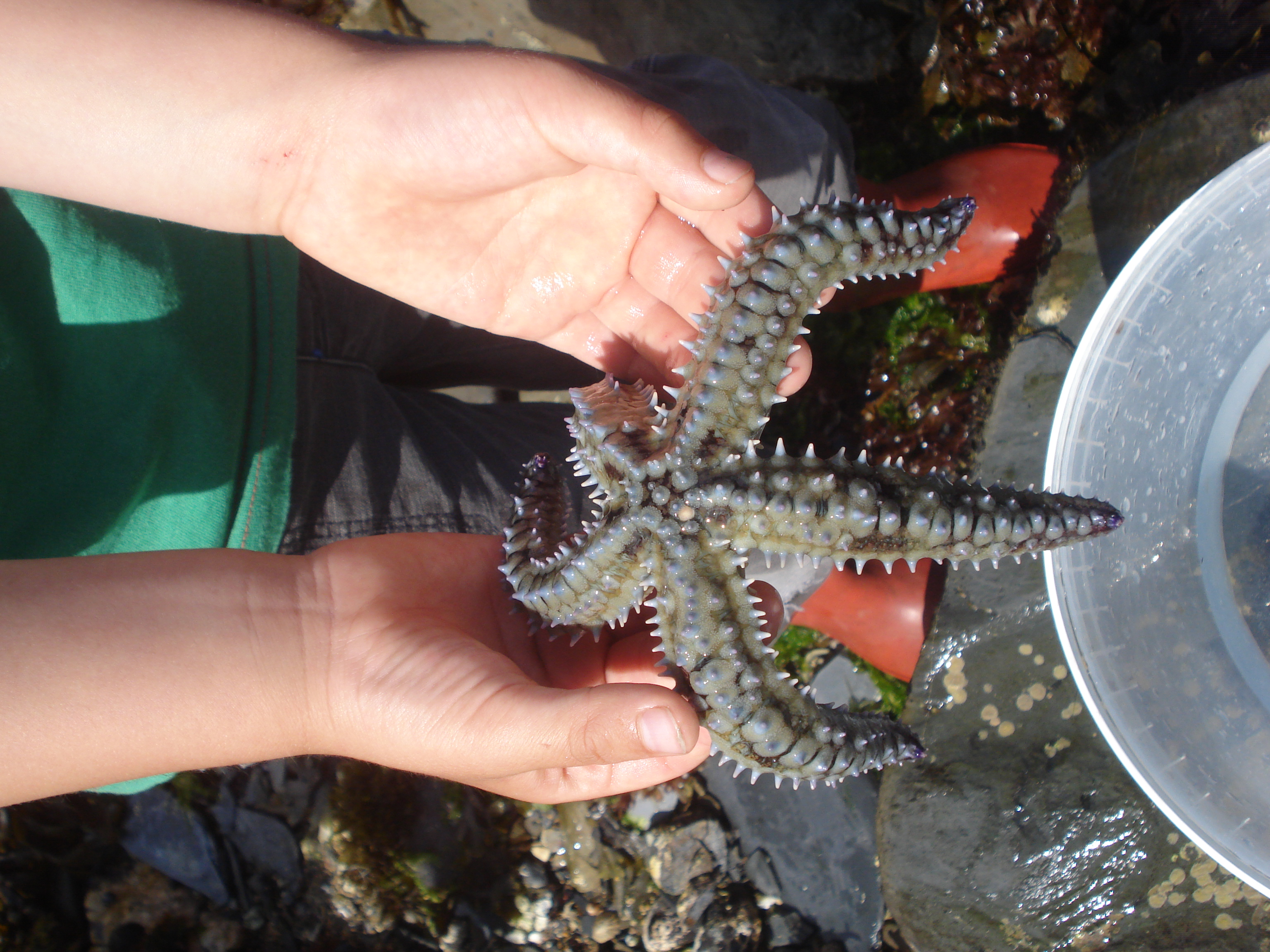
Prisk is an incredibly bio-diverse spot and once again did not disappoint. We headed down to the low tide mark and started to rummage, the first stones turned revealing an abundance of life. We found numerous Cornish suckerfish (Lepadogaster lepadogaster), worm pipefish (Nerophis lubriciformis) many of which had distinct orange eggs under their bellies, and a butterfish (Pholis gunnellus). Crabs also abounded including the ‘body builder’ crab Xantho incises, velvet swimming crabs and broad clawed porcelain crabs (Porcellana platycheles) clinging to the undersides of most rocks. The beautifully coloured colonial seasquirts Botryllus schlosseri and Botrylloides leachi were also found on many undersurfaces at the very low tide. One of the biggest finds was made by one of our younger participants who found a large spiny starfish, Marthasterias glacialis, about 15cm across, and more commonly seen in deeper water when diving. Other highlights included green shore urchins (Psammechinus miliaris) camouflaged with pieces of shell stuck on their spines, squat lobsters (Galathea squamifera), and the ever comical hermit crabs.

Our two hour event on the shore flew by and no-one wanted to stop, but as the tide turned we called it a very successful day and headed back. Those new to Prisk Cove vowing to return to this amazingly rich but little known or disturbed haven.
Ruth Williams
HMCG event leader and Marine Conservation Manager for Cornwall Wildlife Trust.