Seashore Safari, Helford Passage with Ruth Williams

Monday, 18th April 2011

If shellfish, crabs and other marine creatures have an early warning system, it must have clicked on ‘Red Alert’ today as the Seashore Safari got underway.  But to no avail.  A horde of searchers, 30 adults and 45 children, with ages ranging from 2 to 80, was advancing over the rocks, armed with nets and buckets.  There was little chance of any creature remaining undetected as sharp eyes and quick hands and nets probed the rock pools and watery gullies; and soon treasured finds were being placed in the buckets and carried to Ruth for identification.

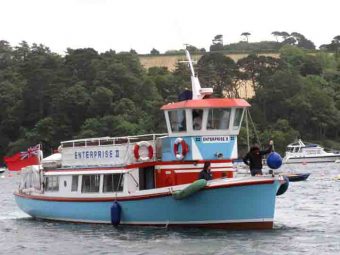
The weather conditions were ideal – a dry, warm, spring day and a slight breeze.  With one of the lowest tides of the year the water was receding fast, leaving the ferry immobile on the sand beside its jetty and allowing us to walk around grounded boats that an hour or so earlier had been riding to buoys.  Limpets, barnacles and mussels on the rocks of the upper shore had closed their shells for the drying out period and beadlet anemones in the small pools had retracted to jelly blobs.  There were topshells in a variety of colours, plus periwinkles, but the main quarry in the larger pools was creatures that moved – small fish including butterfish and different types and sizes of crabs: hermit, shore and velvet swimming crabs, among which was a soft-bodied one that had only recently moulted its outgrown shell.  Easier to capture were small common starfish.  An unusual find was a brown sea hare about 9cm long.

On the lower shore, now uncovered by the receding tide, were abundant sand-encrusted tubes and filigree tentacle umbrellas of the sand mason worm and smaller numbers of peacock worm tubes.  A few marooned scallops were trying to jerk themselves back into the water by slowly opening their shells and then snapping them shut.  Other shells, mostly empty, included native and Pacific oyster, razor shells, chiton, whelk, cockle and slipper limpets.  Gradually the party thinned as parents and children left for lunch, but not before they had thanked Ruth warmly for a very enjoyable and rewarding outing – and one mother took the opportunity to confirm that she had collected the right seaweed to add to her salad!

The HMCG wishes to express its appreciation to Ruth for leading an extremely successful trip.
 

Similar Posts

  • Wildflower Wanderings

    6 May 2007
    Two weeks later Goongillings Farm was again the venue for an HVMCA event but this time it was for an afternoon look at the flowers and other vegetation. A relaxed stroll for the 21 participants with Keith Spurgin and other botanists highlighted the amazing variety of plants appearing on an organic farm under countryside stewardship management. Habitats included woodland with trickling stream, herb-rich meadows with a lake and the upper shore slopes of the saltwater creek. Once again the hospitality offered by Charles and Barbara was greatly appreciated.

  • Wild Foods Walk with Caroline Davey and Ruth Williams

    Sunday, 16th May 2010

    Despite the unpromising weather – overcast and drizzly, 35 enthusiastic members and friends, including 5 children, gathered in Helford Car Park to meet Caroline Davey, the ‘Fat Hen’ food forager from St Buryan, and Ruth Williams from CWT, to learn about what natural foods can be gleaned from the vicinity of the Helford.

  • Rockpool Ramble

    30 August 2007

    Out at sea, yachts were heeIing in a brisk wind. Onshore, all eyes were directed downwards as Ruth Williams explained the mysteries and delights of the Rosemullion rockpools to 9 persons (and a dog). It must he admitted, since it was our dog, that the latter was more interested in splashing than learning: and his curiosity to discover why we were staring quietly and intently into the water was of no help in persuading timid creatures to emerge from their hiding places.

  • Tales of a Wildlife Photographer (David Chapman)

    Saturday, 11th December 2010

    Is that a pin-tailed duck? No, it’s a long-tailed duck. Isn’t that a gannet? No, it’s a black-tailed godwit. We were trying to identify birds on David Chapman’s jumper, knitted by his mother who had produced separate jerseys for different talks. His outdoor gear depended on conditions, one photograph showing military-style camouflaged top and trousers, plus a back-pack to carry a tripod, camera and lenses and a chest-pack containing a portable hide. When erected, the last looked like a camouflaged igloo, just large enough to accommodate David and Adrian Langdon for several hours bird watching at the Walmsley Reserve. His account of that outing was returned by Adrian with the comment that the phrase “the mud came nearly to the top of our wellies” had a typographical error in the final word!

  • The Fal-Helford Marine Special Area of Conservation (Kevan Cook)

    Saturday, 15th January 2011

    Because of its very special nature in terms of habitats, biodiversity, species, geology and scenery, the Helford River has long been recognised as worthy of protection at both European and national levels. Fortunately our speaker, Kevan Cook, Lead Marine Adviser for Natural England, was able to guide us through some of the acronyms. The Fal-Helford SAC (Special Area of Conservation), lying west of a line from St Anthony Head to Manacle Point and giving the highest level of protection, is a European designation relating to habitats and some species.