Helford Conservation Cruise

1st July 2012

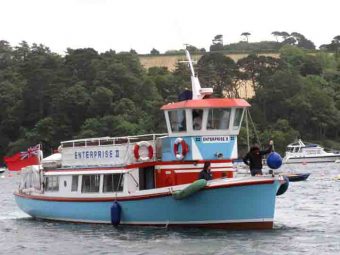
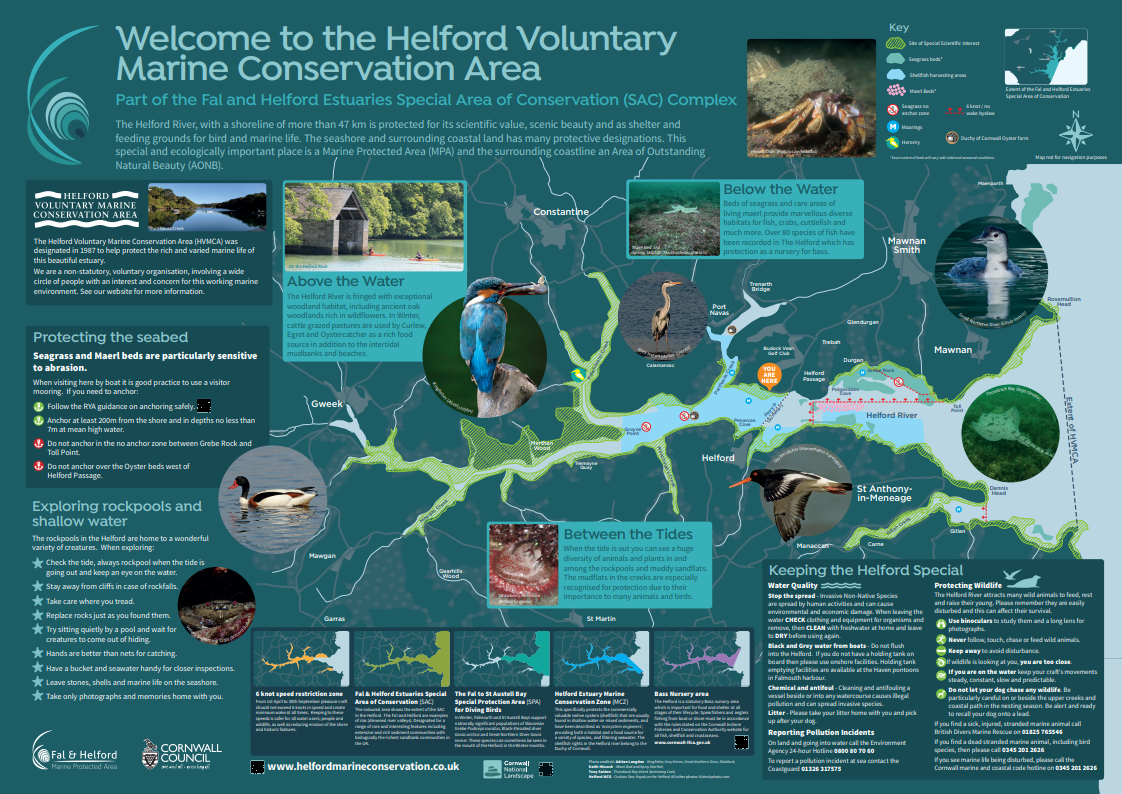
The 19th Annual Conservation cruise set off on a dry day with a few grey clouds and
a brisk westerly wind. The “Enterprise” boat skipper with his intimate knowledge of
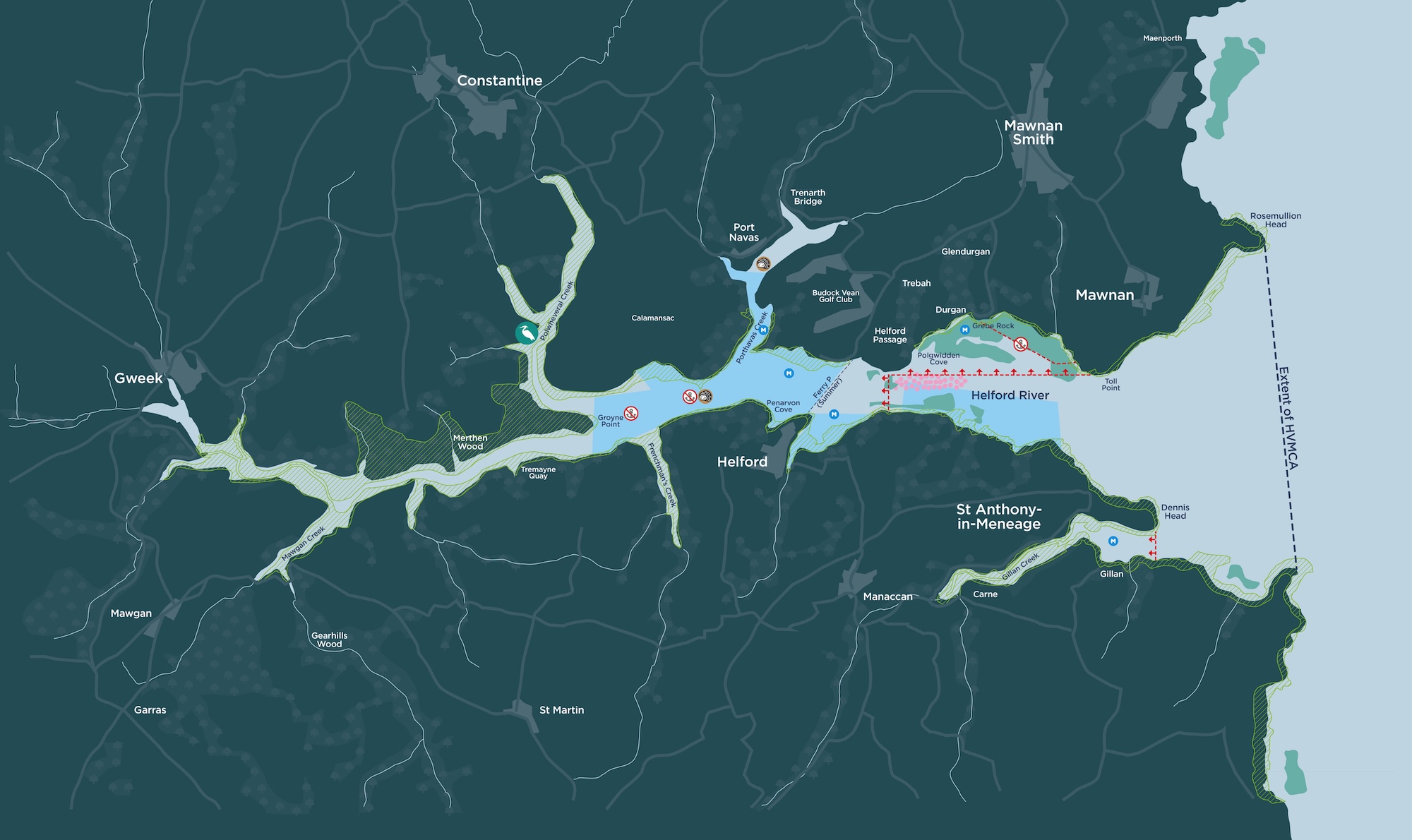
the channels and mud banks took us high up into the creeks, the haunt of shelduck,
sandpiper, redshank, heron and little egret.

A peregrine falcon gave a stunning aerial display over Dennis Head, whilst a sparrowhawk
swooped along the woodland edge in the upper creeks where two pairs of shelduck with
grey downy chicks could be seen awaiting the fall of the tide.

Ancient oak woodland fringed much of the shoreline contrasting with the impressive Sea-
Core Fugro drilling platforms at Gweek.

Sea-water tanks on-board with National Trust volunteers, gave an opportunity to see
various shore species such as crabs and anemones at close quarters.

Whilst the 100 passengers were charmed by the beauty of the trees above the ruffled
water, they also enjoyed their tea or coffee as they learnt more about the birds, the fish
and fishing, management of the land and woods, geology, local history and industries and
most importantly the whole marine web of life.

Sailors and land-lubbers alike appreciated the timeless beauty of the secluded waters,
muddy creeks, woodland tapestry and rocky shores and the importance of protection for
this vulnerable sheltered arm of the sea.

Andrew Tompsett
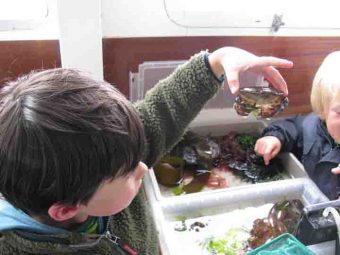
Edible crab. Image: Pam Tompsett.
Helford Marine Conservation Cruise. Image: Pam Tompsett.

Similar Posts

  • Regenerating the Helford Oyster Fishery

    24 March 2007
    After many years under the management of the Hodges family, in 2005 the Duchy of Cornwall Oyster Farm had been acquired by Ben Wright and Wright Bros Oyster Merchants. Ben gave a lively description of his current operations to rejuvenate the native oyster beds by lifting and cleaning all the stock, initially by hand – a daunting task but to be continued with a recently acquired oyster barge.

  • Fabulous Wooded Garden Walk, Gillan Creek

    Free for under 18s and HMCG members. £4 for others. Meet at Hallowarren Barn, Carne. SW 7729 2487  A very rare opportunity to stroll through a fabulous 15 acre woodland garden and wildflower honeypot meadow with owner Amanda Loxley.  There will be a circular walk through the unspoilt woodlands early summer flowers time finishing with…

  • Heron and Egret Survey

    Sunday, 18th April 2010

    What a pleasure to be in the open air, ambling gently along the Calamansack road with the blackthorn bushes in full flower and listening to bird song. The sun shone warmly from a cloudless blue sky and a goldfinch popped on to a nearby hedge to greet the 21-strong party with a cheerful tune. Chaffinch and blue tits added to the chorus, a couple of linnets flew over, twittering, and an unseen dunnock gave forth a beautiful melody. As if in contrast, a green woodpecker ‘yaffled’ in the distance. Turning off the road and across pastured fields we had an uncommon view along Polwheveral Creek, with white houses at its head and above them the village of Constantine, dominated by the church, whose bells were ringing out clearly across the valley.

  • Rockpool Ramble at Prisk Cove

    21st August 2012

    The weather didn’t bode well for our Rockpool Ramble event at Prisk on Tuesday 21st August, with heavy showers hitting hard as we drove to our meeting point. However, by the time we all assembled at Mawnan Church car park the sun was shining and the afternoon turned out to be warm and beautiful. We were a small group with only three families from Helston, Truro and Perranporth, and a keen naturalist from Penzance who very kindly recorded our day’s findings for the Environmental Records Centre for Cornwall and Isles of Scilly. I was also joined by three enthusiastic members of the Helford Marine Conservation Group – Paul Garrard, Dave Thompson and Rhiannon Pipkin.

  • Plankton on Parade

    Saturday, 13th November 2010

    The term ‘plankton’ comes from a Greek word meaning ‘wanderer’ or ‘made to wander’,an apt description for creatures which drift at the mercy of winds and currents. Some are large and easily seen – the Macroplankton, such as jellyfish and the Portuguese man-o’-war. Others are small – the Microplankton, which measure a millimetre or so across – or less – and are studied using a microscope. These are collected with a conical fine-mesh net swept or towed through the water and they include a great variety of plants and animals, in adult or larval stages. There is a third, even smaller, size category – the Nanoplankton, such as coccolithophores, which are just a few microns across and only seen with the aid of an electron microscope.