HMCG Seashore Safari at Helford Passage

4th April 2008

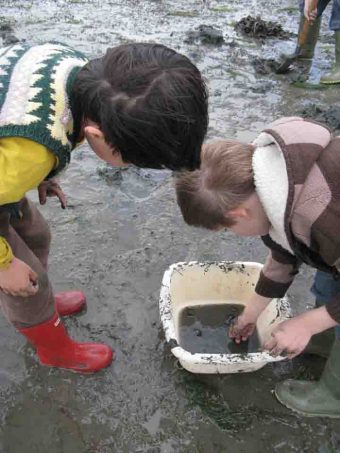
Taking advantage of the extremely low tide and with dry, mild and slightly breci conditions, 40 persons, about half of them young children, assembled at Helford Passage to take part in the Seashore Safari run by Joana Doyle with two helpers from the Cornwall Wildlife Trust. All were enthusiastic, searching the shallow waters on the shore and carefully turning over small rocks to look beneath (and replacing them afterwards). Many creatures were found, to the delight and interest of all, enhanced by the keenness of Joana and her helpers in identifying the wildlife and explaining its habits. Goby and butterfish, sea slug and sea urchin, tube worms, sea-squirt, starfish, various sorts and sizes of crab, the list seemed endless. Mussels, barnacles and limpets festooned the rocky parts. Intriguing structures were produced by mounds of slipper limpets, by mussels attaching small stones and shell fragments to themselves as camouflage and by clusters of whelk eggs. A range of seaweeds and wracks added to the story. Many thanks are due to Joana and her assistants for giving freely of their time, knowledge and enthusiasm, ensuring the success of a very satisfying and informative outing.
Similar Posts

  • Seashore Safari

    Thursday, 1st April 2010

    The beach in front of the Ferryboat Inn resembled a market day, with a group of colourful tables, a banner and a leaflet stand, all weighted by heavy rocks against the brisk, rather chilly wind. Abby Crosby, with Emma and other volunteers, had brought her displays for the Cornwall Wildlife Trust’s ‘Your Shore’ Project, teaming up with Ruth Williams’ ‘Seashore Safari’; and so there was no lack of expert knowledge as people crowded round the tables to look in the tanks and trays at live creatures collected from nearby rock pools.

  • Helford Conservation Cruise

    Sunday, 11th July 2010

    Once again, the weather was kind, producing a warm, dry and wind-free day. With 95 passengers on board, plus tanks containing a variety of live fish, crabs and other creatures, the Enterprise boat headed to the mouth of the estuary and around into Gillan Creek, in sight of St Anthony church. The National Trust owns two small properties on the south bank, one containing Bronze Age barrows and an Iron Age cliff castle. Looking seaward there was a clear view of Nare Point and its observation post, now occupied by Coastwatch, but, during WWII, part of a testing range for air-drop torpedoes.

  • Fabulous Wooded Garden Walk, Gillan Creek

    Free for under 18s and HMCG members. £4 for others. Meet at Hallowarren Barn, Carne. SW 7729 2487  A very rare opportunity to stroll through a fabulous 15 acre woodland garden and wildflower honeypot meadow with owner Amanda Loxley.  There will be a circular walk through the unspoilt woodlands early summer flowers time finishing with…

  • Bats know best!

    Sunday, 6th September 2009

    Over 30 friends and members of the Helford MCG gathered at Mawgan Village Hall for an evening “bat talk and walk”. Dr Carol Williams, with her characteristic enthusiasm, delivered a 30 min. crash course in bat identification, life-cycle and habits before we ventured out into the gathering gloom assembling in the woodland car park on the Trelowarren Estate. Bat detectors swung into action immediately and to our delight we heard several pipistrelle bats as they hunted for insects overhead using their stuttering echo-location calls.

  • Leatherback turtles and their jellyfish prey (Dr Matt Witt)

    31st March 2012

    Of the 7 species of marine turtles, 3 are seen regularly in UK waters: the Leatherback, Loggerhead and Kemp’s Ridley turtles. However, Britain also has interests in overseas waters, such as the Caribbean, and so the work of the Marine Turtle Research Group of Exeter University, based at Tremough, encompasses the world’s oceans. For our speaker, Dr Matthew Witt, the principal study area has been the beaches of Gabon, West Africa. Secluded and little frequented, (although with oilfields offshore), these are the nesting grounds for the world’s largest population of Leatherback turtles.