Seashore Safari

Thursday, 1st April 2010

The beach in front of the Ferryboat Inn resembled a market day, with a group of colourful tables, a banner and a leaflet stand, all weighted by heavy rocks against the brisk, rather chilly wind. Abby Crosby, with Emma and other volunteers, had brought her displays for the Cornwall Wildlife Trust’s ‘Your Shore’ Project, teaming up with Ruth Williams’ ‘Seashore Safari’; and so there was no lack of expert knowledge as people crowded round the tables to look in the tanks and trays at live creatures collected from nearby rock pools.

Carpet shells, top shells, various crabs, hermit crab and beadlet anemone were among them. Abby explained the aims of the Your Shore initiative and then Ruth set off to explore the pools and sand flats. Although the group was relatively small, 12 adults and 2 children, because local schools had not yet broken up for Easter, there was a high level of enthusiasm and interest. The low tide had exposed a wide area of sand, which yielded shells of queen scallop, native oyster, Pacific oyster, small turret shells, cockles and Mya, plus several clusters of invasive slipper limpets. Protruding razor shells pulled themselves rapidly below the surface and squirted as one approached. A marooned great scallop was attempting to jerk itself back to the water by opening its shell and then snapping it shut. Strings of Japweed, another invasive species, were plentiful. In one section the surface was coated with a fine white debris which appeared to be the broken down remains of fan worm tubes. A few tubes, still standing, seemed lifeless.

Back at the tables, two children from a holidaying family brought their rock pool catch for identification. It was an impressive collection and included two butterfish, two worm pipefish, velvet swimming crab, spider crab, shore crab, cushion star, baby sea urchin and bristle worm. There is so much to find on the shore (and it helps to have children as ‘hunters’!). Many thanks are due to Ruth, Abby and all the CWT team for yet another enjoyable day.
Similar Posts

  • Explore the Shore

    Sunday, 23rd August 2009

    “Dare you to put your finger in this bucket!”. Then came a yelp, and a rapid withdrawal of the hand. The Velvet Swimming Crab had instantly reared up, arms wide, claws open, its bright red eyes glistening. Only later, when it had subsided, did we see the flattened back legs, with hair-like fringes, that enable it to swim.

  • Dive Bahamas

    14th November 2009

    Reality sometimes exceeds expectations, sometimes it does not.

    When Helford River diver and expert photographer, Tony Sutton was invited by the Bahamas Tourist Board to dive on the reefs of this Caribbean Archipelago his feelings of good luck and expectations were, not surprisingly, high. Likewise, his audience of Helford River supporters, who, braving the frost, gathered at Mawgan Village Hall expecting to escape in, if only in their imaginations, visions of blue tropical waters, multi-coloured corals and fish of innumerable shapes and sizes.

  • The National Trust around the Helford

    Saturday, 16th October 2010

    Justin Whitehouse, National Trust Area Warden for the Lizard, first became associated with the National Trust as a volunteer shortly after graduating as a botanist and moving to Cornwall in 1994. His daily journey to work involved rowing across the river from Porth Navas to the office at Helford. Subsequently came five years work at Trelissick and then a return permanently to the Lizard, back to the woodlands and creeks that he preferred.

  • Helford Conservation Cruise

    Sunday, 11th July 2010

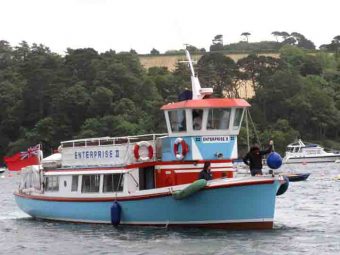
    Once again, the weather was kind, producing a warm, dry and wind-free day. With 95 passengers on board, plus tanks containing a variety of live fish, crabs and other creatures, the Enterprise boat headed to the mouth of the estuary and around into Gillan Creek, in sight of St Anthony church. The National Trust owns two small properties on the south bank, one containing Bronze Age barrows and an Iron Age cliff castle. Looking seaward there was a clear view of Nare Point and its observation post, now occupied by Coastwatch, but, during WWII, part of a testing range for air-drop torpedoes.

  • Leatherback turtles and their jellyfish prey (Dr Matt Witt)

    31st March 2012

    Of the 7 species of marine turtles, 3 are seen regularly in UK waters: the Leatherback, Loggerhead and Kemp’s Ridley turtles. However, Britain also has interests in overseas waters, such as the Caribbean, and so the work of the Marine Turtle Research Group of Exeter University, based at Tremough, encompasses the world’s oceans. For our speaker, Dr Matthew Witt, the principal study area has been the beaches of Gabon, West Africa. Secluded and little frequented, (although with oilfields offshore), these are the nesting grounds for the world’s largest population of Leatherback turtles.