What’s beneath your feet? (Dr Tegwyn Harris)

6th June 2012

Bar beach, Helford Passage

On a slightly blustery afternoon an intrepid group of Helford VMCA members headed out on to Bar Beach to explore the squidgy, muddy but intriguing world living beneath our feet. The event was planned to find, identify and learn a little more about some of the unusual critters to be found hidden in the muddy shores of the Helford River. We all see the mud shores, but to many of us they usually look muddy, flat and not terribly alive, so on this afternoon Tegwyn set out to prove just how much life was there, if only you open your eyes and look.

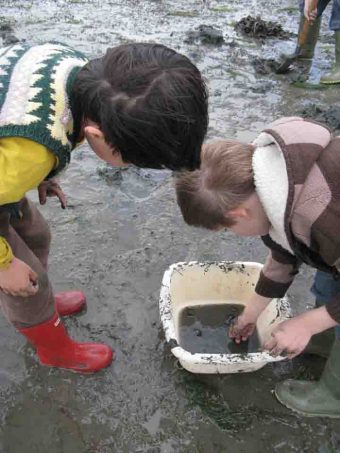
At the start of the event we promptly headed down to the bottom of the shore to begin our exploration. The first thing you notice is that the mud isn’t flat and barren – it is covered in holes, burrows, trails, mounds and strange little structures created by all of the critters living within it. With a few volunteers armed with spades, trowels and buckets it didn’t take long for us to start finding out what had made them. Tegwyn was brilliant, pitching information about the creatures we found at a level understandable by everyone from young children to marine scientists and featuring fantastic analogies including the equivalent of living on essence of fish and chips and body-snatching Hollywood aliens! We found masked crabs (Corystes cassivelaunus) which burrow into the sediment and breathe through a filtering snorkel formed from two antennae, common shore crabs (Carcinus maenas) whose body had been taken over by a parasitic barnacle which occupies its tissues and a range of bristle worms which, although often overlooked, are equally as beautiful and quirky as many of the other more familiar creatures.

Special thanks should go to Dr Tegwyn Harris for his wonderful, animated discussions on the lives of the creatures beneath our feet and for sharing some of his immense knowledge on this subject. Thanks also go to all the Helford VMCA volunteers who turned up, dug in and got muddy and to Matt Slater (Cornwall Wildlife Trust), Rhiannon Pipkin (Natural England), Pamela Tompsett and Dave Thomson (Helford VMCA) for organisation, logistics and making sure everything ran smoothly!

A full list of species found on the day can be found here.

Holly Latham
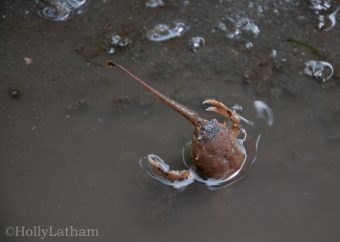
Masked Crab (Corystes cassivelaunus). Image: Holly Latham
What’s beneath your feet? Image: Pam Tompsett

Similar Posts

  • Rockpool Ramble at Prisk Cove

    21st August 2012

    The weather didn’t bode well for our Rockpool Ramble event at Prisk on Tuesday 21st August, with heavy showers hitting hard as we drove to our meeting point. However, by the time we all assembled at Mawnan Church car park the sun was shining and the afternoon turned out to be warm and beautiful. We were a small group with only three families from Helston, Truro and Perranporth, and a keen naturalist from Penzance who very kindly recorded our day’s findings for the Environmental Records Centre for Cornwall and Isles of Scilly. I was also joined by three enthusiastic members of the Helford Marine Conservation Group – Paul Garrard, Dave Thompson and Rhiannon Pipkin.

  • Dawn Chorus Beside Polwheveral Creek

    22 April 2007
    An early start did not deter an eager band of some 28 people armed with binoculars converging on Goongillings Farm where a delicate grey mist swirled amongst the trees edging the creek. The expertise of Martin Rule, the group leader was much appreciated in recognising the songs of the unseen vocalists. Charles and Barbara Pugh rounded a very successful expedition with hot drinks and refreshments amid requests for an even earlier start next year!!

  • Wildflower Wanderings

    6 May 2007
    Two weeks later Goongillings Farm was again the venue for an HVMCA event but this time it was for an afternoon look at the flowers and other vegetation. A relaxed stroll for the 21 participants with Keith Spurgin and other botanists highlighted the amazing variety of plants appearing on an organic farm under countryside stewardship management. Habitats included woodland with trickling stream, herb-rich meadows with a lake and the upper shore slopes of the saltwater creek. Once again the hospitality offered by Charles and Barbara was greatly appreciated.

  • Leatherback turtles and their jellyfish prey (Dr Matt Witt)

    31st March 2012

    Of the 7 species of marine turtles, 3 are seen regularly in UK waters: the Leatherback, Loggerhead and Kemp’s Ridley turtles. However, Britain also has interests in overseas waters, such as the Caribbean, and so the work of the Marine Turtle Research Group of Exeter University, based at Tremough, encompasses the world’s oceans. For our speaker, Dr Matthew Witt, the principal study area has been the beaches of Gabon, West Africa. Secluded and little frequented, (although with oilfields offshore), these are the nesting grounds for the world’s largest population of Leatherback turtles.

  • Plankton on Parade

    Saturday, 13th November 2010

    The term ‘plankton’ comes from a Greek word meaning ‘wanderer’ or ‘made to wander’,an apt description for creatures which drift at the mercy of winds and currents. Some are large and easily seen – the Macroplankton, such as jellyfish and the Portuguese man-o’-war. Others are small – the Microplankton, which measure a millimetre or so across – or less – and are studied using a microscope. These are collected with a conical fine-mesh net swept or towed through the water and they include a great variety of plants and animals, in adult or larval stages. There is a third, even smaller, size category – the Nanoplankton, such as coccolithophores, which are just a few microns across and only seen with the aid of an electron microscope.