The National Trust around the Helford
Saturday, 16th October 2010
Justin Whitehouse, National Trust Area Warden for the Lizard, first became associated with the National Trust as a volunteer shortly after graduating as a botanist and moving to Cornwall in 1994. His daily journey to work involved rowing across the river from Porth Navas to the office at Helford. Subsequently came five years work at Trelissick and then a return permanently to the Lizard, back to the woodlands and creeks that he preferred.
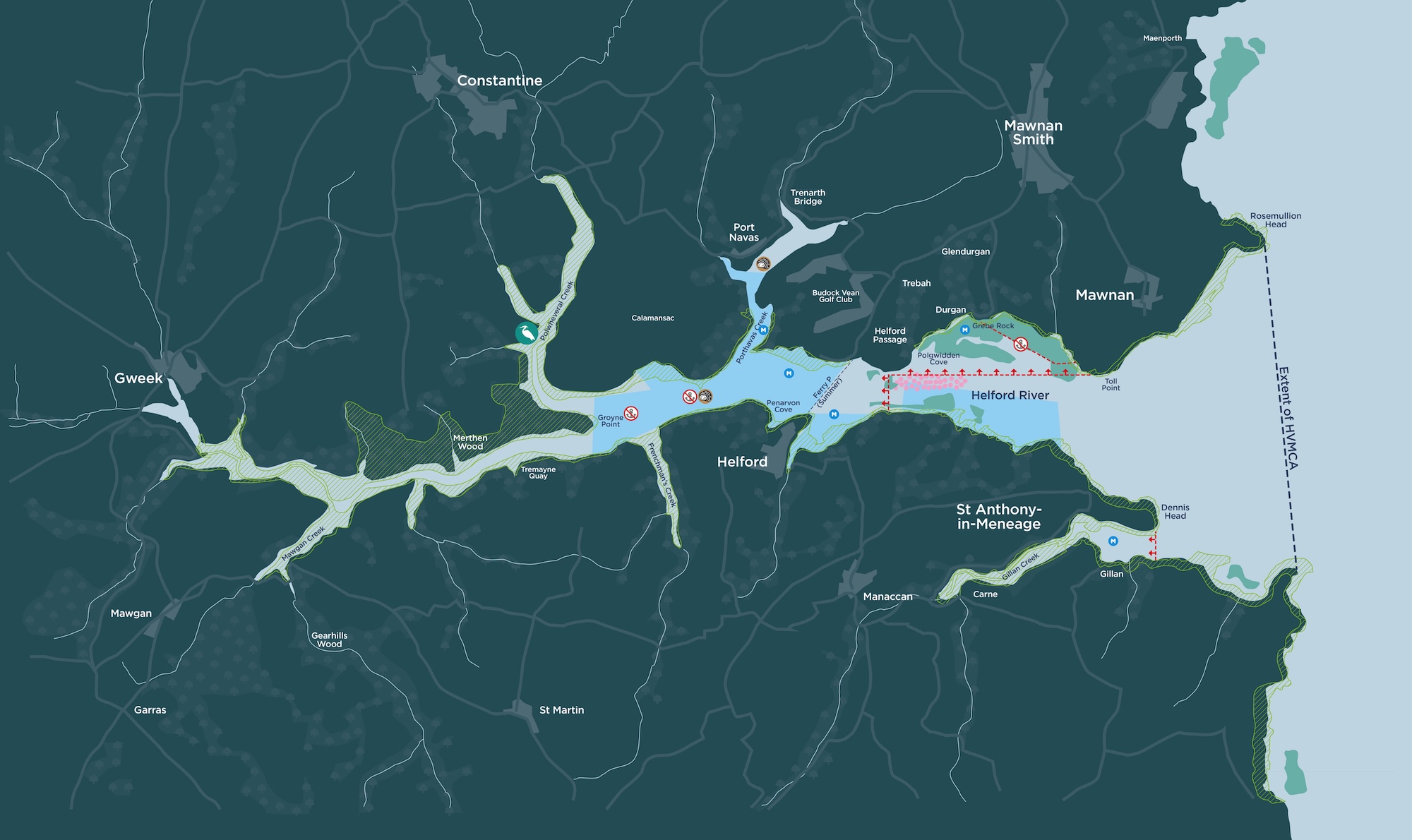
He began his talk by taking us on a picture tour of the numerous Trust properties around the Helford, starting in the north-east at Rosemullion Head. Here, above the ever-popular shoreline with its magnificent rock pools, the cliff top is farmland, worked under restricted tenancies and with careful control of practices such that it is one of the few places in the country where one can find the very rare green-winged orchid (also present at another Trust property, Kynance Cove). Journeying westwards we passed Toll Point, where gun emplacements guarded the mouth of the Helford during WWII, thence to Durgan where the National Trust owns three-quarters of the houses, two of them holiday cottages and the remainder long-lets. The wondrous Glendurgan Gardens to the north were planted in the early 1800s by the Fox family, shipping agents and Quakers. On the south side of the river the Trust’s properties, Penarvon, Frenchman’s Creek, Kestle and Tremayne, are mainly woodland and creek-side. They are among the few places where the public can gain access to the south shore west of Helford. Tremayne Woods were originally part of the Trelowarren Estate. Tremayne Quay and its access track were built, or at least up-graded, for an anticipated visit by Queen Victoria in 1846. She didn’t come, but the quay eventually received a royal visitor when the Prince of Wales, later Edward VIII, landed there in the 1920s. Farther east lies Frenchman’s Creek, a picturesque and wonderful wildlife habitat fringed with sessile oak woodlands, its intertidal muds attracting birds such as kingfishers and egrets. The name probably refers to a French sailing vessel not a person. Continuing eastwards, the Trust holds properties at Gillan Creek, Carne and Nare Point, the last mostly farmland managed for conservation. Nare Point was used as a decoy site during WWII to lure enemy bombers away from Falmouth Docks. The observation post that was part of an air-drop torpedo testing range is now occupied by Coastwatch.
The National Trust’s properties on the south side of the Helford are dominantly woodland, some of it ancient and some which has reverted from former farmland. Consequently most of its activities centre on woodland management, although time has to be found also to maintain about 10 miles of footpaths, collect beach litter and deal with the thankfully minor amounts of vandalism. A programme to eradicate the harmful Rhododendron ponticum has been running for about 30 years. A more recent problem, since c. 2007, has been the arrival of the fungus which causes Sudden Oak Death. This attacks a variety of species, such as rhododendron, laurel, larch, beech and bilberry, usually non-fatally, but they in turn become sources of spores which eventually kill oak. The potential impact here could be devastating and the situation is being monitored closely by DEFRA. There is also full awareness of invasive species such as Japanese knotweed, beech and Spanish bluebells.
In earlier years coppicing was an important activity, producing wood for charcoal and firewood and bark for tanning. The last commercial operations were pre-war, but the Trust has now re-introduced coppicing in Tremayne Woods, with the pleasing result that gaps and glades in the woodland have seen the return of bluebells and butterflies. When felling is necessary the trees are tagged and surveyed and the final stump is made jagged to provide a wildlife habitat. Much more could be done in the way of managed timber extraction, not just in Cornwall, which is the second least-wooded county, but throughout the UK to reduce the unnecessarily large quantity of timber imports. As well as caring for the health of its woodlands the Trust is recording and measuring large old trees as part of the Ancient Tree Forum. A prime example is a holly tree at Frenchman’s Creek, about 6m across and possibly 700-800 years old, with an old stone well beneath. Very likely this is one of the markers of an old routeway, the district name Meneage meaning Land of the Monks or Monks’ Way. Additionally there is a programme to monitor notable trees, such as old ones marking hedgerows and period plantings such as Monterey Pines from the 1920s. Nearly all the work in the woods is done by volunteers, many of them holidaymakers plus some more permanent local volunteers, in total amassing some 10,000 workdays a year.
The Trust’s properties are a haven for wildlife. Little egret, grey heron, kingfisher and great spotted woodpecker are among the birds that can be seen. Tremayne boathouse is shared by barn owls and greater horseshoe bats, the latter being vary rare in the UK. About 6 bat species occur in the surrounding woods. Lichens are common here, whereas in the UK as a whole 70% have become extinct since the Industrial Revolution. Fungi, indispensable to the health of woodland, proliferate. In addition to caring for the physical well-being of its properties, the Trust manages a number of holiday cottages ranging from simple buildings to the luxury Bosloe House and the eco-showpiece of ‘Powders’, with its solar panels, woodchip boiler and lambswool insulation.
The National Trust has recently adopted a new outlook, nationwide. No-one in the UK is more than half-an-hour’s journey from a Trust property, but these are under-utilised and the aim is for everyone to have at least some involvement by 2020, replacing the long-established image of a frozen heritage, older visitors, teashops and proscriptive signs with a friendly welcome and opportunities for young and old to learn, enjoy and participate. The Trust’s properties around the Helford and the Lizard provide almost unequalled potential for children, in particular, to take part in activities such as building dens, canoeing, coasteering and camping, as well as learning bushcraft and woodland crafts such as bodging, using a pole lathe, making charcoal and picket fencing. They can cut hazel and make their own boat or raft, erect a tree swing, play, learn to take risks, get dirty and wet, as children used to, whilst benefiting from supervision and instruction. It’s an exciting prospect.
The HMCG would like to thank Justin very much for his wide-ranging and absorbing talk.